

40 Years of Rolex Paris Masters – Episode #3: Paris, the city of light (2006 – 2015)
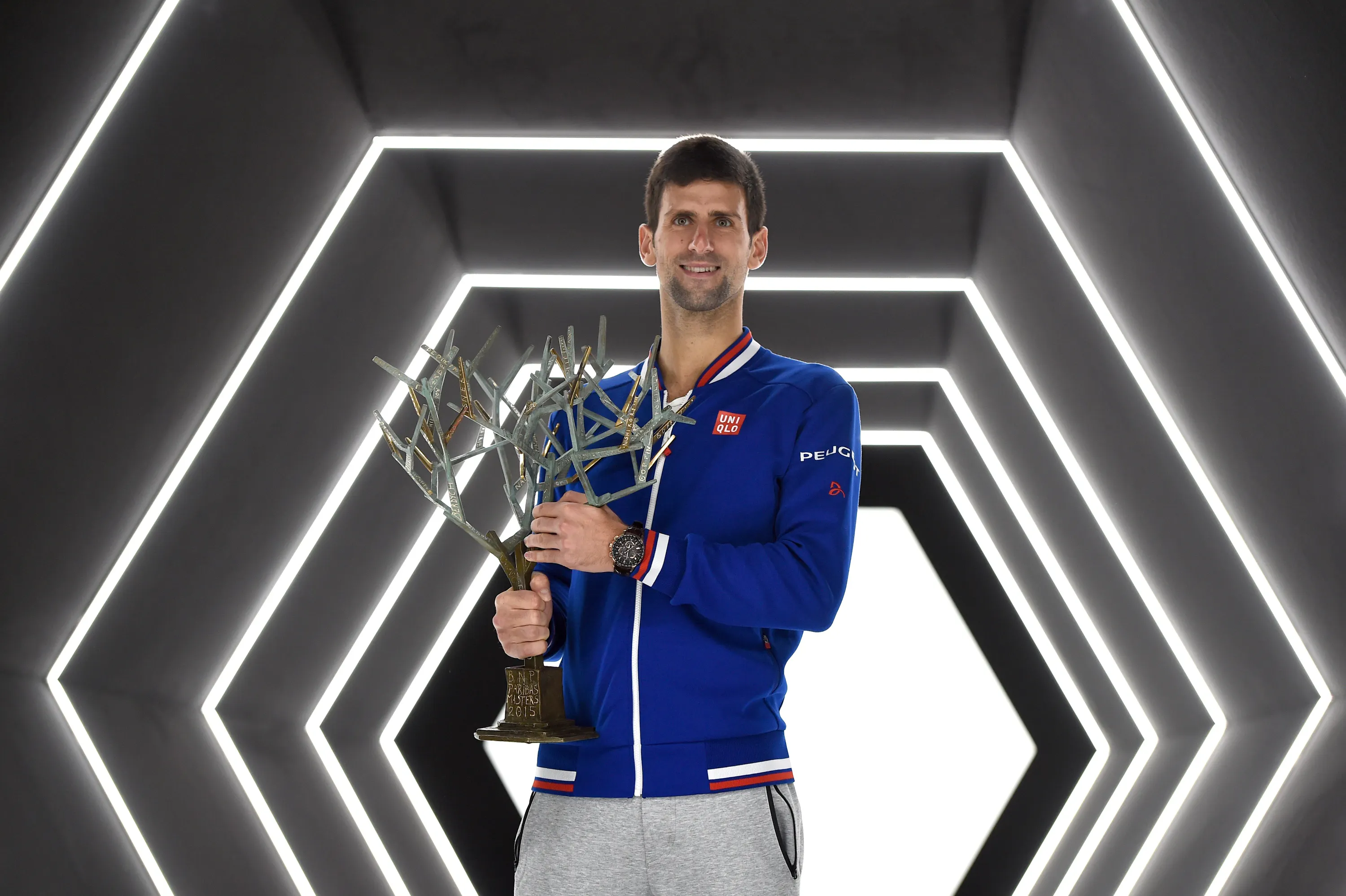
Our Rolex Paris Masters anniversary series continues as the tournament celebrates its 40th anniversary in 2026. During its third decade (2006 – 2015), the Paris event embraced a new direction and further strengthened its identity. It was the golden age of the Big Four and, more specifically, the era of Novak Djokovic, who turned Paris into one of the favourite stages of his remarkable reign.
The defining champion: Novak Djokovic
Since its inception in 1986, the Rolex Paris Masters had never really needed to force its identity. The tournament had always been synonymous with innovation, entertainment and modernity. But by the time it celebrated its 20th anniversary in 2006, an edition marked by the introduction of Hawk-Eye and Nikolay Davydenko’s dominant victory over Dominik Hrbaty in the final (6-1, 6-2, 6-2), the event found itself at a crossroads, much like an ATP Tour in the midst of transformation. To enter a new era, the tournament chose to fully embrace the future.
Under the leadership of a new tournament director, Jean-François Caujolle, who took charge from 2007 to 2011, the Rolex Paris Masters developed a distinctly American-style entertainment experience around the matches, featuring sound-and-light shows, DJ sets and a more underground visual identity that perfectly matched the energy, personality and urban spirit of Paris. Player entrances became increasingly spectacular, culminating in the introduction of the now-famous illuminated tunnel in 2015, which would go on to become one of the defining symbols of the Paris Masters. It proved an immediate success and reflected the growing stature of a tournament that would continue attracting the world's very best players.
The 2007 edition also symbolised this turning point in several other ways. It marked the end of five-set finals, the introduction of the "Sunday Start" and, perhaps most significantly, a surface change from carpet to resin-coated wooden courts, the surface that remains in use today. David Nalbandian adapted immediately. The Argentine claimed the title after achieving the remarkable feat of defeating Roger Federer in the Round of 16 before overpowering Rafael Nadal in the final, 6-4, 6-0. He would return to the final a year later, only to be denied by the new star of French tennis, Jo-Wilfried Tsonga, who prevailed 6-3, 4-6, 6-4 to become the third French champion in tournament history after Guy Forget (1991) and Sébastien Grosjean (2001).
Tsonga, who would also finish runner-up to Roger Federer in 2011 (6-1, 7-6(3)) as the Swiss maestro finally captured the Paris title many had long expected him to win, was undoubtedly one of the defining figures of the decade. So too was fellow French Mousquetaire Gaël Monfils, who reached back-to-back finals in 2009 and 2010, losing first to Novak Djokovic (6-2, 5-7, 7-6(3)) and then to Robin Söderling (6-1, 7-6(1)). David Ferrer also left his mark, claiming the trophy in 2012 against surprise qualifier Jerzy Janowicz (6-4, 6-3) before being dethroned a year later by Novak Djokovic (7-5, 7-5).
Ultimately, however, it was Djokovic who emerged as the defining champion of this era, transforming the Rolex Paris Masters into his favourite Masters 1000 event. In his early appearances, the Serbian delighted the crowds by entering the court wearing Halloween masks during the tournament's traditional late-October dates.
But after his victories in 2009 and 2013, he had more serious ambitions in mind. In 2014, just days after the birth of his first son, Stefan, Djokovic defeated Milos Raonic 6-2, 6-3 in the final to become the first player to successfully defend the Paris title. He repeated the feat a year later, defeating world No.2 Andy Murray 6-2, 6-4.
Djokovic's golden years coincided with a period of extraordinary growth for the tournament itself. Attendance now exceeded 130,000 spectators and, for the first time, the entire world Top 10 was present at the 2015 edition. For Djokovic, that fourth title elevated him above both his then-coach Boris Becker and Marat Safin in the tournament's record books. And he was far from finished.
But that is a story for the next chapter, devoted to the fourth decade of a tournament that, after thirty remarkable years, could confidently look towards the future, knowing it was in excellent hands.
Champions (2006 – 2015)
2006: Nikolay Davydenko d. Dominik Hrbaty (SVK) 6-1, 6-2, 6-2
2007: David Nalbandian (ARG) d. Rafael Nadal (ESP) 6-4, 6-0
2008: Jo-Wilfried Tsonga (FRA) d. David Nalbandian (ARG) 6-3, 4-6, 6-4
2009: Novak Djokovic (SRB) d. Gaël Monfils (FRA) 6-2, 5-7, 7-6(3)
2010: Robin Söderling (SWE) d. Gaël Monfils (FRA) 6-1, 7-6(1)
2011: Roger Federer (SUI) d. Jo-Wilfried Tsonga (FRA) 6-1, 7-6(3)
2012: David Ferrer (ESP) d. Jerzy Janowicz (POL) 6-4, 6-3
2013: Novak Djokovic (SRB) d. David Ferrer (ESP) 7-5, 7-5
2014: Novak Djokovic (SRB) d. Milos Raonic (CAN) 6-2, 6-3
2015: Novak Djokovic (SRB) d. Andy Murray (GBR) 6-2, 6-4